Wonderlic test: format, scoring and how to prepare
On this page
Quick answer
| Test | Wonderlic Select (formerly called Wonscore), per Wonderlic’s candidate FAQ |
| Sections | Three: a timed cognitive section and two untimed sections (motivation and personality) |
| Cognitive section | 50 questions, 12 minutes. Test takers are not expected to finish all 50 |
| Other sections | Motivation: 58 items. Personality: 150 items. Both untimed |
| Total time | About 35 minutes on average, per Wonderlic |
| Calculator | No |
| Pass mark | Wonderlic says there is no “passing” or “failing” grade and no universal good or average score |
| Cost to you | Nothing. Wonderlic says it does not sell tests to individuals |
| Who decides | The employer who sent you the link |
Your employer chooses how the test is used. Your invitation is the final word on what you will see.
What is the Wonderlic test?
The Wonderlic Select test is used by employers as part of an application. Wonderlic describes it as three sections that measure cognitive ability (your ability to learn, adapt and solve problems), motivation (the types of work and activities you find most interesting) and personality (how you react to people, tasks and situations at work) (Wonderlic candidate FAQ, published October 2, 2025).
The company sells to employers. Wonderlic says there is no cost to test takers and that a company asking you to pay for “a Wonderlic test” is likely selling practice material that is not affiliated with Wonderlic. Wonderlic also says it has been in the testing business for over 80 years (Wonderlic history).
If you have heard of an older “Wonderlic score out of 50”, that belongs to older versions. Wonderlic says today’s Wonderlic Select does not give a single numerical cognitive score. More on this in the scoring section.
How many questions and how long?
Wonderlic’s FAQ says most people finish the full assessment in about 35 minutes. The three parts:
| Section | Items | Timing | Right and wrong answers? |
|---|---|---|---|
| Cognitive ability | 50 | 12 minutes, timed | Yes, this is the only section with them |
| Motivation | 58 | Untimed | No |
| Personality | 150 | Untimed. Wonderlic’s sample says it typically takes about 15 minutes | No |
Sources: Wonderlic candidate FAQ; the timing note for personality is from Wonderlic’s sample assessment (PDF).
Twelve minutes for 50 questions is about 14 seconds a question on average. That is our arithmetic, not a Wonderlic figure. Wonderlic says test takers are not expected to complete all questions in the time. In its sample instructions it says many people do not finish.
Plan your pace
50 questions, 12 minutes (Wonderlic, read October 20, 2026). Wonderlic says test takers are not expected to finish.
AttemptBank for review
Nothing you enter is saved or sent.
Seconds per question = minutes x 60 / 50. Banked time is the unattempted questions at the standard pace. Our arithmetic, not a recommendation to leave questions unanswered.
| Attempt | Standard pace | Review at standard pace |
|---|---|---|
| 50 | 14.4 s | 0 s |
| 40 | 14.4 s | 2 minutes 24 seconds |
| 30 | 14.4 s | 4 minutes 48 seconds |
Wonderlic: Wonderlic Select candidate FAQ, read October 20, 2026.
Try six invented items
Original practice, written in the style of the skills Wonderlic describes. Unofficial, not affiliated with Wonderlic. These are not real test questions, do not predict anything, and carry no score.
Nothing you enter is saved or sent.
At 12 minutes for 50 questions, you have about 14 seconds a question (Prepti’s arithmetic, not a Wonderlic figure). An optional timer shows the suggested seconds; there is no time-out and no penalty.
Invented by us
Skill: unit rates
Notebooks come in packs of 4 for $6 a pack. How much do 20 notebooks cost?
Worked explanation: Find the packs first: 20 / 4 = 5 packs. Then price them: 5 × $6 = $30. Two short steps beat one long one.
Common slip: Pricing each notebook at $6 and getting $120. The $6 is per pack, not per notebook.
Invented by us
Skill: percentages
What is 15% of 240?
Worked explanation: Split the percent: 10% of 240 is 24, and 5% is half of that, 12. Add the parts: 24 + 12 = 36. Breaking 15% into 10% + 5% is faster than long multiplication.
Common slip: Stopping at 24 (that is only 10%) or at 12 (only 5%). The answer needs both parts added.
Invented by us
Skill: analogies
LADDER is to CLIMBING as CANOE is to:
Worked explanation: Say the relationship as a short sentence first: “a ladder is used for climbing.” So the answer is what a canoe is used for: paddling. Object-to-purpose, not object-to-setting.
Common slip: Picking RIVER or WATER. That is where a canoe goes, not what it is for - the relationship is use, not location.
Invented by us
Skill: word meanings
Which word is closest in meaning to BRIEF?
Worked explanation: Brief means short in time or length. Match the meaning itself, not the setting the word reminds you of.
Common slip: Picking LEGAL because a “brief” is also a legal document. The question asks for the closest meaning, not an association.
Invented by us
Skill: ordering
Marta is taller than Jo. Jo is taller than Priya. Who is the shortest?
Worked explanation: Chain the facts before answering: Marta > Jo > Priya. The name at the bottom of the chain is the shortest. Two facts that share a name always chain.
Common slip: Choosing “cannot be determined” when the facts chain cleanly, or answering with the first name you read.
Invented by us
Skill: categories
Which word does not belong with the others? POUND, OUNCE, GRAM, MILE
Worked explanation: Say what the group measures: pound, ounce and gram are all units of weight. A mile measures length, so it breaks the group.
Common slip: Choosing GRAM because it is metric and the others are not. The bigger split is weight versus length.
That was all six invented items.
Practice by skill
For unit rates and percentages, start with the percentage and ratio foundations in our numerical reasoning guide, then try the free numerical reasoning test. Its percentage and proportion items use related calculation steps, but do not cover every unit-rate problem.
For analogies, word meanings and categories, the free verbal reasoning test has analogy, closest-meaning and category odd-one-out items.
For ordering, our logical reasoning guide explains deductive reasoning and suggests using a line to map an order. The free logical reasoning test covers number and letter patterns, not ordering.
For a mixed set, try the free Wonderlic practice test.
Different versions exist. JobTestPrep’s page mentions a shorter online variant of 30 questions in 8 minutes (JobTestPrep, checked October 15, 2026). We could not find that on Wonderlic’s candidate pages. If your invitation shows different numbers, trust the invitation.
Where you take it. Wonderlic says the test is typically not proctored, though some companies may choose to proctor it. Links generally stay active for a maximum of 14 days, and Wonderlic cannot resend an invitation: contact the hiring company. See our at-home test checklist.
What’s on the Wonderlic?
The cognitive section
Wonderlic says the questions feature challenges related to simple math, basic logic, language comprehension, spatial reasoning, pattern identification and more, and that they become increasingly difficult as the test progresses (Wonderlic cognitive ability page). It also says the questions do not measure knowledge. They test your ability to apply logic and reason to pick an answer (candidate FAQ).
Wonderlic’s own sample assessment has five cognitive questions. From its wording, the kinds are: picking the earliest of several dates, completing a word analogy (“LOW is to HIGH as EASY is to…”), choosing the graph that fits a set of numbers, finding the next number in a series, and finding the opposite of a highlighted word in a sentence (sample PDF, checked October 15, 2026). Use that PDF first. It is the only official sample we found.
The families we use below follow Wonderlic’s list: number and pattern, simple math, language, logic and spatial. Dates, which show up in the official sample, get their own short set.
Motivation
Wonderlic’s sample shows sets of three work activities. You pick the one you would most like to do at work, then your favorite of the remaining two. The instructions say not to think about your education or pay, only how much you would like or dislike the activity. There are no right answers.
Personality
Wonderlic’s sample shows statements such as “I can keep calm, even in heated discussions”, answered with Agree, Neither Agree nor Disagree, or Disagree. The sample instructions say to respond candidly and not to choose a response because it describes the way you might like to be. See Can you prepare for a personality assessment?.
Worked examples
These questions are written by Prepti. They are unofficial and are not Wonderlic questions. They show the type of thinking each family needs and the quickest way through it. Real items are harder as the test goes on. Answers are at the end of each set. Time yourself at about 15 seconds each for the early ones, if you like.
Example 1: Number and pattern series
Q1. 4, 9, 14, 19, 24, ?
Q2. 2, 6, 18, 54, ?
Q3. 3, 5, 9, 15, 23, ?
Q4. 100, 91, 83, 76, ?
Q5. 5, 20, 7, 18, 9, 16, ?
Show answer and reasoning
- Q1: 29. The gap is always 5. Check two gaps and move on.
- Q2: 162. Each number is 3 times the one before. When the numbers grow fast, try multiplying.
- Q3: 33. The gaps are 2, 4, 6, 8, so the next gap is 10. When the gaps themselves change, write them out.
- Q4: 70. The gaps are -9, -8, -7, so the next is -6. Same idea, going down.
- Q5: 11. Two series are woven together. The odd places go 5, 7, 9, so the next is 11. The even places go 20, 18, 16. If a series looks random, split it into odd and even places.
Example 2: Simple math
No calculator is allowed. These are built so you can do them in your head. Wonderlic says only a small number of questions need calculations (candidate FAQ).
Q1. Five pens cost $3.50. How much do eight pens cost?
Q2. 45 is 60% of what number?
Q3. A worker is paid $12 an hour and works 6.5 hours. How much are they paid?
Q4. A car travels 90 km in 1.5 hours at a steady speed. How long does 150 km take at that speed?
Q5. The ratio of boys to girls in a class is 3 to 5. There are 40 students. How many are girls?
Show answer and reasoning
- Q1: $5.60. One pen is $0.70, so eight are $5.60. Find the price of one first.
- Q2: 75. If 60% is 45, then 10% is 7.5, so 100% is 75. Work from 10%.
- Q3: $78. 6 hours is $72, and half an hour is $6.
- Q4: 2.5 hours. The speed is 90 / 1.5 = 60 km/h. 150 / 60 = 2.5.
- Q5: 25. The ratio has 3 + 5 = 8 parts. 40 / 8 = 5 per part. Girls are 5 parts, so 25.
Example 3: Language
Q1. WARM is to HOT as COOL is to ___ ? (wind, cold, soft, blue, snow)
Q2. What is the opposite of the word brief in this sentence? “The committee gave a brief reply.” (short, long, polite, late, clear)
Q3. Which word is closest in meaning to RELUCTANT? (eager, unwilling, quick, certain, tired)
Show answer and reasoning
- Q1: cold. Say the relationship out loud: “hot is a stronger version of warm”. The match is the stronger version of cool.
- Q2: long. Read the word in its sentence. “Brief” here describes a reply, and its opposite is “long”.
- Q3: unwilling. Drop the answer choices that describe something else (quick, tired, certain). “Eager” is the opposite, and a common trap.
Example 4: Logic
Q1. Tom is taller than Ria. Ria is taller than Sam. Who is shortest?
Q2. Pat finished after Max but before Lee. Who finished last of the three?
Q3. If the alarm sounds, the door locks. The door is not locked. What follows?
Q4. Ana said she would come only if Ben came. Ben said he would come only if Cara came. Cara did not come. What can you say for certain?
Show answer and reasoning
- Q1: Sam. Put them in a line: Tom, Ria, Sam.
- Q2: Lee. The order is Max, Pat, Lee.
- Q3: The alarm did not sound. If the alarm had sounded, the door would be locked. It is not, so the alarm did not sound. Do not go the other way: a locked door would not prove the alarm sounded.
- Q4: Neither Ana nor Ben came. Ben needed Cara, and Cara did not come. Ana needed Ben. Use only what the question says.
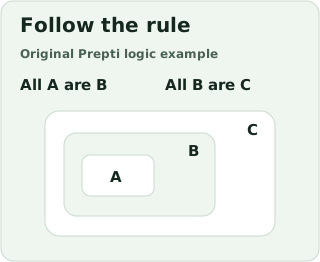
Groups inside groups. Rules like “all A are B” run in one direction. Picture A as a small box sitting inside a bigger box B, and B sitting inside a bigger box C. If all A are B and all B are C, then every A is also a C. A rule does not run backwards: it does not follow that every C is an A. The diagram shows how the groups sit inside one another. It does not say that any A exists. For example: every sparrow is a bird and every bird is an animal, so every sparrow is an animal. That does not make every animal a sparrow. Use the same habit with the questions above: take only what the rules say, and do not turn a rule around.
Example 5: Spatial and perceptual
These questions use words and numbers only; one worked answer below uses a small diagram. Real items may use images.
Q1. What is the smaller angle between the hands of a clock at 3:00?
Q2. What is the angle between the hands at 2:30?
Q3. A cube is painted on every face, then cut into 27 equal small cubes (3 by 3 by 3). How many small cubes have paint on exactly one face?
Q4. How many times does the letter E appear in REFERENCE?
Q5. How many of these pairs are identical? 4172 – 4172, 9035 – 9053, 2288 – 2288.
Show answer and reasoning
- Q1: 90 degrees. 3 hours is a quarter of the clock.
- Q2: 105 degrees. At 2:30 the minute hand is at 180. The hour hand has moved halfway from 2 to 3, which is 60 + 15 = 75. The gap is 105.
- Q3: 6. Only the middle cube of each face has exactly one painted face, and a cube has 6 faces. (For reference: 8 cubes have three painted faces, 12 have two, 1 has none. 6 + 12 + 8 + 1 = 27.)
- Q4: 4. Count them in order: R-E-F-E-R-E-N-C-E.
- Q5: 2. The middle pair swaps its last two digits.
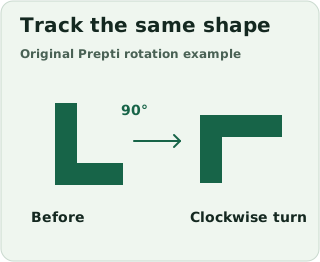
What a clockwise quarter turn does. Turn a shape a quarter of a full turn clockwise, as a clock hand moves. What was on its left goes to the top, what was at the top goes to the right, and what was on the right goes to the bottom. The shape keeps its size and proportions. It is turned, not flipped. A flip is a mirror image, which swaps left and right without turning the shape. In the diagram, the long arm of the L stood upright on the left. After the quarter turn it lies along the top. The short foot pointed right at the bottom. Now it points down at the left end.
Example 6: Dates and ordering
Q1. Which is the earliest date? Mar 3, 2011, Feb 18, 2011, Feb 5, 2012, Jan 28, 2011, Feb 2, 2011.
Q2. If today is Wednesday, what day is it 10 days from now?
Show answer and reasoning
- Q1: Jan 28, 2011. Compare the year first, then the month, then the day. Careful with the day-month order.
- Q2: Saturday. Ten days is one week plus three days. Wednesday plus three is Saturday.
Is there a good or passing Wonderlic score?
What Wonderlic says (checked October 15, 2026):
- There is no universal “good” or “average” score for the Wonderlic Select test.
- Unlike previous versions (Wonscore), today’s Wonderlic Select does not provide a single numerical cognitive ability score. The three results (cognitive ability, motivation, personality) are combined and evaluated against the demands of the specific job (candidate FAQ).
- The cognitive section’s scoring uses your overall response pattern, and weights each question by its difficulty and the impact of guessing. Wonderlic says this gives a more precise estimate than the total number of correct answers alone (cognitive page).
- The weight the cognitive section carries against motivation and personality varies with the job. Wonderlic gives the example that cognitive ability might matter more for a senior engineering role than for an entry-level support role (same page).
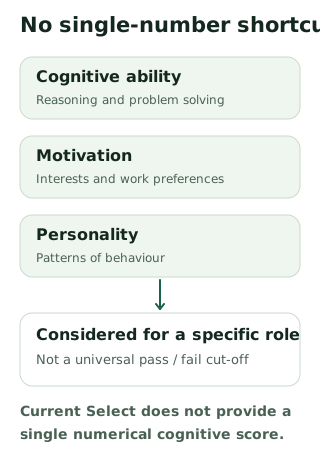
What we do not know: the scoring algorithm itself, how any employer sets a cut-off, whether your employer filters on one section, and how many correct answers a given job needs. Wonderlic does not publish these on the pages we read. We do not invent them.
Other numbers online. Wonderlic’s current statement is above: no universal good or average score, and no single numerical cognitive score for Select. Average scores quoted for older Wonderlic tests should not be treated as Select benchmarks. Prepterminal’s course page now also distinguishes older average-score claims from current Select scoring (checked October 28, 2026). We publish no pass mark or score benchmark for any role.
How to prepare
Wonderlic says preparation and study are not necessary and that there is no pass or fail. It points to free sample questions and gives this advice: use good test-taking strategies, do not spend too much time on any one question, and do not skip around hoping to come back (candidate FAQ). The sample instructions add that guessing is not likely to improve your score, but if you think you know the answer, mark your best choice and move on.
The plans below are written by Prepti. They are suggestions built on those owner statements, not Wonderlic advice.
Strategy for the 12 minutes
- Early questions are the easiest. Wonderlic says they get harder as the test goes on, so do not stall on the first ones.
- Do not skip around. Wonderlic says so directly.
- Do not use a calculator. It is not allowed, and Wonderlic says it is unlikely to help.
- If a question is taking too long, mark your best choice and move on.
- Expect to be unfinished. Wonderlic says that is normal.
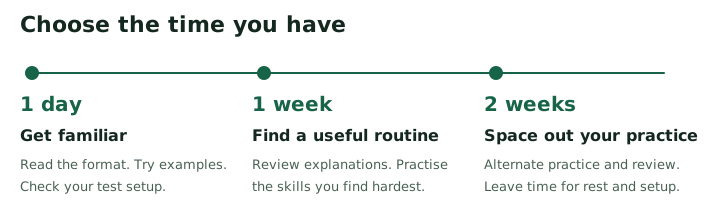
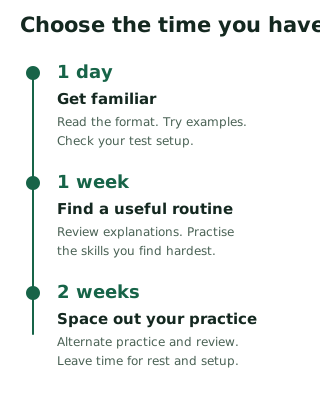
Plan: 1 day
- Read the official sample PDF and answer the five cognitive questions with a 60-second timer. About 5 minutes.
- Do the worked examples above, one family at a time. About 30 minutes.
- Do one run on a plain timer: 12 minutes of mixed questions, no calculator.
- Set up a quiet room and a laptop with a working connection. Read the at-home checklist.
- Sleep. A tired mind is slower than a missed topic.
Plan: 1 week
- Day 1: read the sample PDF and try it timed.
- Days 2 to 4: one family a day (number series, simple math, language, logic and spatial). Do 15 to 20 questions untimed, then the same number timed.
- Day 5: mixed 12-minute run. Note which families cost you time.
- Day 6: repeat your slowest family.
- Day 7: rest. Check your device and the invitation.
Plan: 2 weeks
- Week 1 follows the plan above.
- Week 2: do two full timed runs of 12 minutes, one midweek and one near the end, with a review after each. Practice mental arithmetic without a calculator for 10 minutes a day. Do the personality and motivation sections only by reading Wonderlic’s sample, since there are no right answers to learn.
- Keep your last two days light.
What not to do
Do not try to guess “what the employer wants” on the personality section. Wonderlic’s sample tells you to respond candidly. Its retesting guide says its scoring algorithm can flag a response pattern that looks like an attempt to create an overly favorable perception, or an unusually large share of one type of response (Wonderlic help center). Answer the way you actually work.
If the clock makes you anxious, see test anxiety.
Free Wonderlic practice
- Official: Wonderlic’s sample assessment (PDF) has five cognitive, five motivation and some personality items. Wonderlic’s candidate hub also links FAQs and downloadable study guides.
- Prepti: a free practice test of original questions in the style of a short timed cognitive test (unofficial, not affiliated with Wonderlic), plus the worked examples above.
Retakes, calculators and adjustments
- Retakes. Wonderlic’s guide for employers says it recommends retesting only when a retest warning appears. Warnings come when the full 12 minutes was not used (for example internet loss or closing the browser), or when the personality response pattern is atypical. Retests of the cognitive section use a different form, and Wonderlic says it is generally not advisable to test a candidate more than twice on any section. Your employer decides whether to offer one (Wonderlic help center, updated over 2 years before our check, so rules may have changed). See retaking an employer assessment.
- Calculator. No. Wonderlic says it is not designed to test math skills, and that few questions involve calculations. See calculator rules.
- Adjustments. Wonderlic says accommodations are provided by the prospective employer. Contact them directly, with as much information as possible, and they consult with Wonderlic. See assessment accommodations.
- Invitations. Wonderlic says it cannot resend your invitation. Ask the hiring organization. See Got an assessment invite?.
Paid prep options
Looking at paid practice? Our Wonderlic prep comparison checks free starting options, version coverage, access and refund limits. Match the version in your invitation before choosing a pack.
Wonderlic vs CCAT vs SHL
- Wonderlic Select: a 12-minute, 50-question timed cognitive section, plus untimed motivation and personality sections.
- CCAT (Criteria): one 15-minute test with 50 questions. See CCAT test prep.
- SHL: a family of tests, such as verbal, numerical and inductive, usually separate timed tests. See SHL test prep.
You do not choose. The employer picks the test. See Which test am I taking?.
FAQ
What is the Wonderlic test?
Wonderlic Select is a three-part assessment used by employers: cognitive ability, motivation and personality. It was formerly called Wonscore. Source: candidate FAQ.
How many questions are on the Wonderlic?
The cognitive section has 50 questions in 12 minutes. The motivation section has 58 items, and the personality section has 150. Source: same FAQ.
How long does the whole test take?
About 35 minutes on average, per Wonderlic. Only the cognitive section is timed.
Is the Wonderlic hard?
Wonderlic says it is not hard but is challenging, and that everyone finds some questions harder. Only the cognitive section has right and wrong answers.
What is a good Wonderlic score?
Wonderlic says there is no universal good or average score for Wonderlic Select. Employers evaluate the combined results against the job.
What is a passing score?
Wonderlic says there is no passing or failing grade. Some employers may use their own cut-offs. We found none published.
Can I use a calculator?
No, per Wonderlic.
Do I need to study?
Wonderlic says no. Free sample questions are available if you want to prepare.
Is it proctored?
Wonderlic says typically not, but some companies may choose to proctor it.
Can I retake it?
That is up to the employer. Wonderlic recommends retests mainly after a retest warning, and generally no more than twice per section.
How do I get my results?
Wonderlic says the only candidate results are the Candidate Feedback Report, available if your employer provides a link, not a traditional numerical cognitive score. Employers have immediate access to results when the assessment ends. Wonderlic says prevailing laws generally do not require employers to share results with candidates (Wonderlic candidate FAQ).
What if my link says “Assessment not available”?
Wonderlic says links generally stay active for a maximum of 14 days, and that it means the link has expired or been disabled. If it appears sooner, the employer has made it unavailable. Contact the employer.
Should I answer the personality questions as the employer would like?
We would not. Wonderlic’s sample asks for candid answers, and its retesting guide says its algorithm can flag atypical response patterns.
Sources and last checked
All checked October 15, 2026.
Core Wonderlic format, scoring and retake guidance, the official sample, and the listed providers’ plan prices were rechecked October 28, 2026. Prepterminal’s course contents and current scoring wording were also updated against its page on that date. Other dated comparisons retain their original check dates.
- Wonderlic, Select test FAQs for candidates (October 2, 2025)
- Wonderlic, Cognitive ability test
- Wonderlic, Sample assessment PDF (file dated July 11, 2024 in its name)
- Wonderlic, Candidate hub
- Wonderlic Help Center, Retesting Wonderlic Select candidates
- JobTestPrep, Wonderlic PrepPack
- Prepterminal, Wonderlic course
Found something wrong or out of date? Tell us.
Related: CCAT test prep, SHL test prep, Which employer test am I taking?, Free vs paid prep.
See how we rank and check and our affiliate disclosure.